
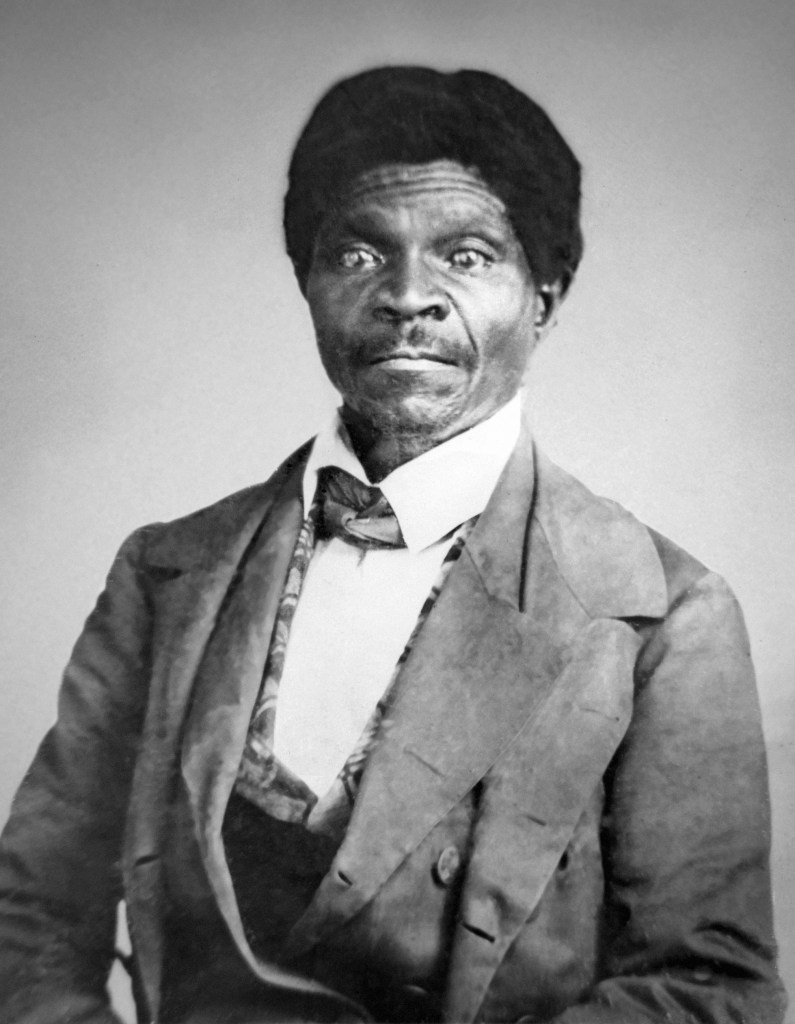
Right now, in social studies, we are learning about the factors that prompted the civil war, including the Missouri Compromise, the Triangular Slave Trade, the Mexican American War, and many cases. One of them is the Dred Scott Case which draws my attention.
Dred Scott is an enslaved man who belonged to Dr. John Emerson who moved from Missouri (slave state) to Illinois (free state) and then finally to Wisconsin territory (free territory). During the stay at Fort Snelling, Dred Scott met another enslaved woman who belonged to an army officer, Harriet Robinson. They soon fell in love, got married in 1836 or 1837, and had two daughters. In 1840, the couple and their daughters moved back to St. Louis with Dr. Emerson and his wife, Irene Emerson.
Everything was going perfect until the Scott family found out Irene Emerson, 1846. The family was devastated and tried to sue the Emersons with the fact that once a slave step into a free territory or state, they are free and cannot be taken back to a slave state. The Scott family actually one in the smaller courts and the protests were so big that it was taken to the Supreme Court in which the Supreme Court justice Roger B. Taney came to the conclusion of… No, you are not free.
”As an African American, Scott “had no rights which the white man was bound to respect,” and was therefore not eligible bring a suit to court. – Taney.
Mr. Taney stated that Dred Scott was in fact, not a citizen, and so he will not be protected by the constitution. Therefore, he has no right to sue his owner.
This decision caused a more clear line of the North and the South. It caused the abolitionists in the North to be outraged, while the South celebrates their win. This also caused the Supreme Court to be looked down upon as people blame the Supreme Court to side with the South.
However, in further research on Mr. Taney. I realized that he didn’t believe in slaves. He was born in the south and freed all his slaves while also paying the old slaves who were unable to work. He believed that owning slaves is an evil practice and will be eliminated by the states in time. However, one problem he did not consider was that even though America stepped out of the slave trade, all the of the slaves that are on mainland, and their children, and their children will all be slaves, and the cycle goes on forever.
Ruling against Dred Scott on the case was Roger Taney’s idea of trying to balance the commotion. And though his original idea was great, the effect was prohibiting the civil war.
If you ask me, I believe Mr. Taney did the correct thing. Though it led to the Scott family hiding for decades, and led the civil war to erupt, I believe that a war was going to happen in a matter of time. Sometimes, when two parties have so different ideas, a clash must occur to determine who will win.
Mr. Taney was in the spot where whichever choice he chose will be hated by one party. By choosing against Dred Scott, he is following the rules of the Constitution. The Constitution did not state whether if an African American can sue their owners. However, it did state that it was to protect all white men and women who are citizens of the United States. Slaves were not citizens of the country and so could not sue.
What Mr. Taney did only made the Civil War happen earlier, which is a good thing. Because after the commotion was settled and the North won, the country could focus on different things such as building trains, and helping with economic growth.


Leave a Reply