
Philips Andover Summer just ended. It was so much fun. Thank you to my friends, classmates, teachers, counselors and everyone else for making the past month so memorable, meaningful, and special. I’ve learned many things throughout this camp, and I would like to share more about my experience in the robotics session. I now understand robotics by experience and knowledge.
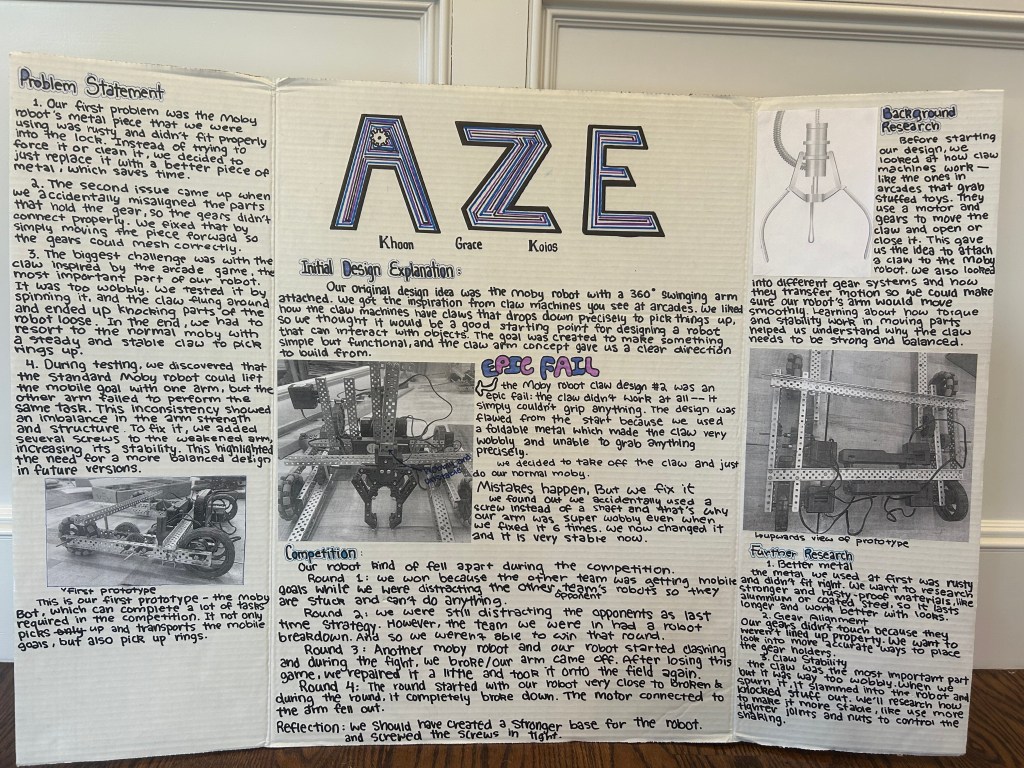
Inside the classroom, I had lots of fun getting to know how to build a robot and program it to pick up mobile goals. During the process, I learned how though having your team work together as collaboration is very important, the division of labor is also crucial. We are all split into teams of three, and two people take the position of building the robot while the other one collects materials and take notes on the important tasks completed. It was super fun and I learned a lot about building robots, different motors and gear ratios, torques…
But I would like to emphasize on this book called The Fourth Age: Smart Robots, Conscious Computers, and the Future of Humanity, that we read during the session. This book truly helped me explore the further concept of technology, robots and the question of consciousness, the development of AI, and the impact the fourth age will bring (including human’s perspective). As you all know, I was completely a novice when entering the classroom, and this book gave me a deeper understanding on philosophical questions beyond robotics. In here, I would like to include a short discussion question paragraph that I wrote and analyse how it changed my feelings towards AI.
Discussion Question: Which types of jobs or industries do you believe will remain “robot-proof” over the next 50 years? Explain why and connect your answer to concepts from this section.
Answer to Question: I believe that a few types of jobs will most likely remain “robot-proof”. The first one is lower class jobs, such as a waiter in a restaurant. This is because robots are usually running by code and are told what to do by humans, and according to the book in a scenario in which a baby was crying, or a man choked on food, or water spillage on the floor, the robot has no idea what to do because they are not programmed to clean up the spillage, or call 9-1-1 for the man, or potentially comfort the baby by giving them a lollipop. The easiest movements of cleaning up and inferences such that five-year-olds can do and make, appear to be the hardest jobs for robots. Another job that cannot be replaced would be the high-class jobs, such as the ones who program robots. Those people act as an important part of the development of AI and instead of losing jobs like many people in the world, are making more fortune than ever. They are now currently safe for at least the next 50 years as robots are far from gaining consciousness and would have to learn from highly experienced humans. The last type of jobs that may still be “robot-proof” would be those that are more appealing to the eyes, such as ballerinas. Imagine on Christmas Eve when you paid money for seats to watch the Nutcracker and dozens and hundreds of robots came performing. Even though robots can be programmed to do infinite pirouettes (ballerina spinning on one leg), they would still look clumsier than a human as the human bones and muscles are very different from the joints and metal of robots. There might be a day in which robots are as flexible as humans, but that is definitely not over the course of the 50 years.
From this paragraph, you can see that I’ve been doing some critical thinking. In fact, before reading the book, I never even thought of the idea that AI, robots, or anything technology related could be conscious. The clearest example I remember from author Bryon Reese is when he mentioned that when you delete an app from your home screen of your technology device, and all the other apps start shaking. Is this consciousness? Are they shaking in fear because they are scared you will delete them too? Or are they programmed to shake this way? If they are programmed, why would the programmers make them shake when clearly you are only deleting one app?
If you start talking about questions, consider yourself lucky, because I have a bunch prepared for you. Do you think computers are conscious? What is the definition of consciousness? We know that robots are designed to do the 3Ds, dull, dirty, and dangerous. If robots are also conscious, what makes them more inhuman than us to take the jobs that we don’t want to do? Humans have always been more superior than any other animals because of our intelligence, when robots become more intelligent than us in every way, are we still going to rule the world, or be ruled? Would robots be counted more human than us? In that case, do we have to redefine the meaning of humanity, or living, or consciousness, or intelligence?


Leave a Reply